Beyond the likes: Marketing metrics for investors you must include in your Pitch Deck
Rocio Romero ·
Investors seek solid data beyond social media popularity. Learn the three essential marketing metrics—CAC, LTV, and Churn Rate—that prove your startup’s viability and growth potential in your pitch deck.
Posts
Ideas, copy and a content calendar that sound like your brand
You have an incredible product, a committed team, and a vision that could change the market. But when you sit in front of an investor, it all boils down to one fundamental question: «Is this business viable?». And no, the answer isn't in your thousands of Instagram followers or that post that went viral.
Investors have seen hundreds of brilliant ideas fail under their own weight. That is why they look for patterns, data that proves your growth engine is real, predictable, and, above all, profitable.
In this article, we will focus exclusively on the three marketing metrics for investors that your pitch deck must include. We will teach you how to calculate them, understand them, and, most importantly, present them to prove that your startup is not just a passionate project, but a solid investment opportunity.
The 3 marketing metrics that prove your startup's viability
To demonstrate the viability of your marketing, you need to focus on three KPIs that, together, tell a complete story: how much it costs you to win a customer, how much value that customer brings you, and whether you can keep them.
1. CAC (Customer Acquisition Cost)
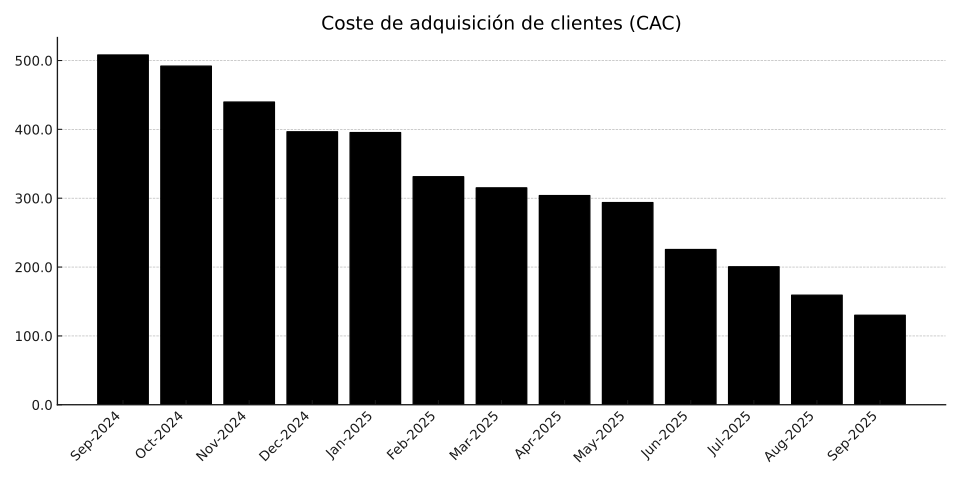
The CAC is what you invest in marketing and sales to acquire a new customer. It is the metric that proves you have a plan for predictable growth.
How is it calculated?
Over a given period (month or quarter), add up your marketing and sales costs and divide them by the number of new customers acquired.
CAC = Total Marketing and Sales Cost / Number of New Customers Acquired
In your pitch deck: Don't just list the number. Show a simple graph of your CAC evolution. If it has decreased over time, explain it: «We optimized our campaigns, which reduced the CAC by 20% in the last quarter». This shows that you don't just invest, but you learn and optimize.
2. LTV (Lifetime Value)
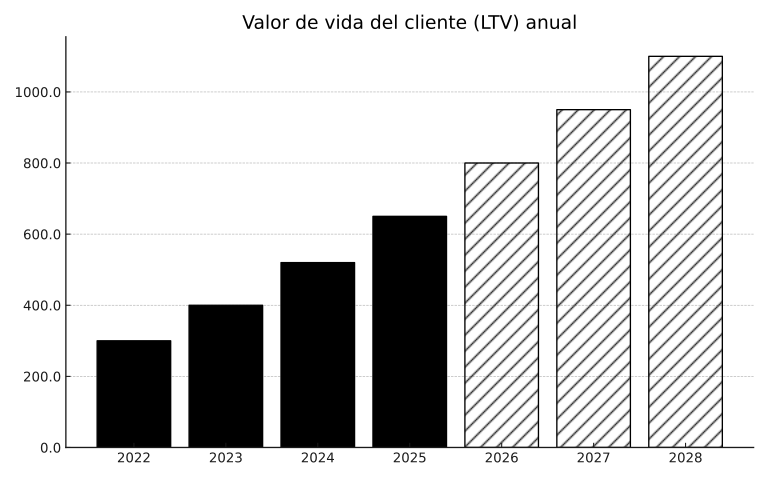
LTV represents the total revenue you expect from a customer throughout your entire relationship with them. It is proof that your business doesn't just acquire users, but generates real, recurring value.
How to calculate LTV for non-recurring models (e-commerce, services, etc.)
For these models, the most used formula is based on three components:
Average Order Value (AOV): How much does a customer spend, on average, each time they buy from you?
AOV = Total Revenue / Number of Orders
Purchase Frequency (F): How many times does a customer buy from you, on average, in a given period (usually a year)?
F = Total Number of Orders / Number of Unique Customers
Customer Lifetime (T): For how many years, on average, does a customer keep buying from you? This is the hardest data to estimate at the beginning. It can be calculated with historical data or, if you are a new startup, by making an estimate based on the market (for example, 1-3 years).
With these three variables, you can calculate the LTV:
LTV = AOV × F × T
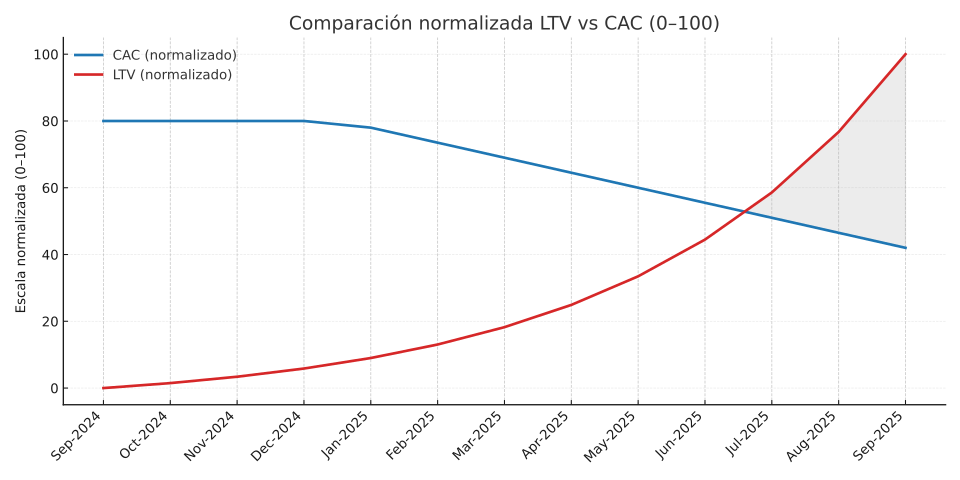
In your pitch deck: The LTV is the prize. Visually, it should be much greater than the CAC. A good pitch deck design uses bar charts or blocks to visually compare the cost (CAC) with the reward (LTV).
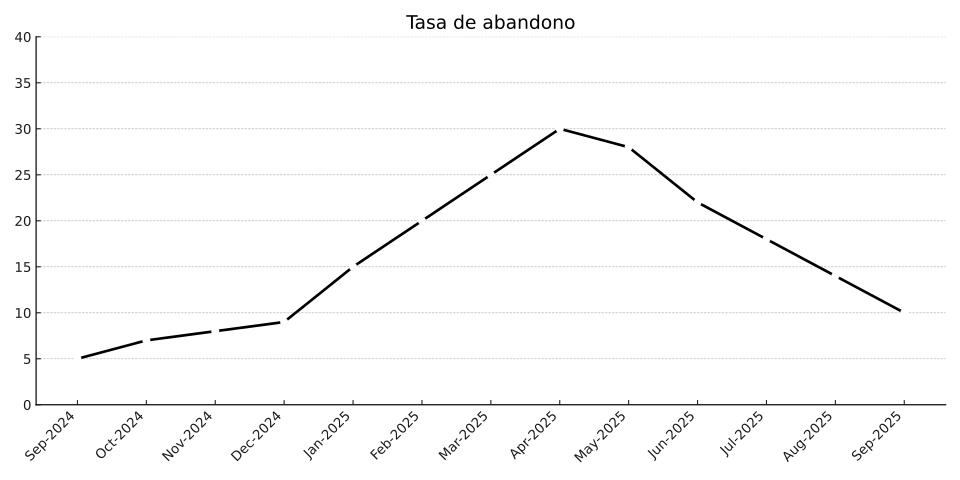
Churn is the percentage of customers who leave you in a period. It is the most honest metric in your pitch deck: it tells investors if your product truly makes people fall in love and solves a problem.
How is it calculated?
Churn Rate = (Number of Lost Customers / Number of Customers at the Beginning of the Period) × 100
In your pitch deck: A low (or decreasing) Churn is one of your best weapons. Show a downward-trending line chart. Explain why it is falling: «See this drop? That was when we implemented X solution». It shows that you listen to the market and are constantly improving.
The gold metric: the LTV / CAC ratio
The LTV/CAC ratio is the ultimate indicator of the health and profitability of your marketing.
A general rule accepted in the startup world is that a healthy LTV/CAC ratio should be at least 3:1.
This means that for every euro you invest in acquiring a customer, you get three back over the course of their lifetime.
If your ratio is 1:1, you are losing money (because you aren't counting operating costs).
If your ratio is less than 3:1, your business model is inefficient.
If your ratio is 5:1 or higher, you have a growth machine on your hands, and it is an excellent time to hit the accelerator (and invest more in marketing).
The metrics you should ignore in your Pitch Deck
Now that you know where to look, it is just as important to know what to ignore. Vanity metrics are those that make you feel good but do not correlate with revenue or profitability.
Social media likes and followers: They don't pay the bills.
Page views: If they don't convert, it's just traffic.
Number of app downloads: If users delete it the next day, they are useless.
The value of these metrics lies in the marketing and advertising goals of each brand; and therefore, they are also important. But honestly, they don't interest investors.