From 18 Months to 5 Minutes: The Sentiment Analysis Used by Multinationals, Now at Your Fingertips
Rocio Romero ·
AI models like Gemini now enable freelancers, SMEs, and startups to perform brand sentiment analysis in minutes, turning public perception into actionable business insights.
Posts
Ideas, copy and a content calendar that sound like your brand
Until recently, a comprehensive sentiment analysis was a project that consumed 6 to 18 months of work and a considerable investment in equipment and software for multinationals. Today, thanks to the evolution of AI models like Gemini, any brand can run a similar analysis in a matter of minutes. The ability to understand public perception is no longer a luxury for large corporations, but a tactical tool accessible to freelancers, SMEs, and startups. Knowing what is being said about your brand in real-time is no longer a competitive advantage; it is the new standard for operating with intelligence in the digital market.
What is sentiment analysis and why is it a brand management tool?
Sentiment analysis is the automated process of identifying and classifying opinions expressed in text to determine if the author's attitude toward a topic, product, or brand is positive, negative, or neutral.
Far from being a simple vanity metric, it is a fundamental management tool with direct applications in business strategy:
Problem detection: Identify customer friction points and potential reputation crises before they escalate.
Product feedback: Gain honest information about which features or aspects of your service are liked and which need improvements.
Competitive intelligence: Monitor the perception of competitors, revealing their weaknesses and opportunities for your brand.
Campaign validation: Measure the reception of your marketing actions to optimize resource allocation and messaging.
Integrating this technique into your operations allows you to make decisions based on qualitative data at scale, transforming network noise into business intelligence.
Pro Tutorial: Brand Reputation Monitoring with Gemini
This is not a basic tutorial. It is a professional workflow to extract actionable intelligence using Gemini. It is designed for profiles who understand technology as a business multiplier and are looking for tangible results.
Context: Let's imagine we are a specialty coffee brand selling online and we want to analyze our reputation.
Phase 1: Data Collection and Structuring
The analysis is only as good as the data feeding it. You need a clean source of comments.
Extraction: Gather comments from your key channels. You can do this manually, but for recurring analysis, consider using scraping tools like PhantomBuster or Apify to extract comments from Instagram, or export reviews from your Google Business profile.
Cleaning: Dump all data into a spreadsheet (Google Sheets or Excel). Create two columns: Comment and Source (e.g., Instagram, Google, Blog). This will allow you to segment the analysis later.
Tip: If your company has high relevance, at least at a national level, you can directly ask Gemini for the scraping, analysis, and report with the 'Deep Research' search option enabled.
Phase 2: Initial Analysis and General Classification
With your data ready, open Gemini. The first step is to get an overview.
Prompt 1 (General Classification):
"Act as a data analyst specializing in Natural Language Processing. I will provide you with a CSV dataset containing customer comments about a specialty coffee brand. Your task is to:
1. Analyze each comment in the 'Comment' column.
2. Add a new column named 'Sentiment' and classify each as 'Positive', 'Negative', or 'Neutral'.
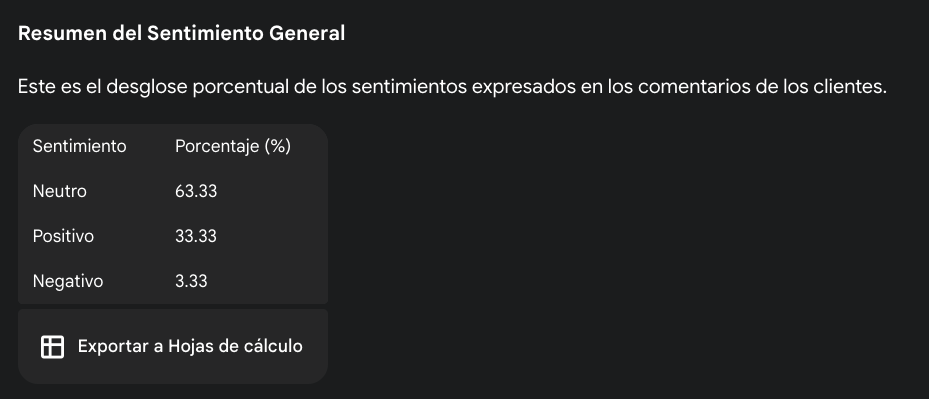
3. Calculate and present the total percentage for each sentiment category.
4. Return the result in a formatted table."
Result:
Phase 3: In-depth Negative Sentiment Analysis
This is where the strategic value lies. Isolate the negative comments and dig deeper.
Prompt 2 (Root Cause Analysis – Negative):
"Based on the table above, take only the comments classified as 'Negative'. Perform the following analysis:
1. **Thematic Grouping:** Group comments into thematic clusters (e.g., 'Shipping Times', 'Product Quality', 'Customer Service', 'Price').
2. **Root Cause Analysis:** For each topic, summarize the main problem described by customers.
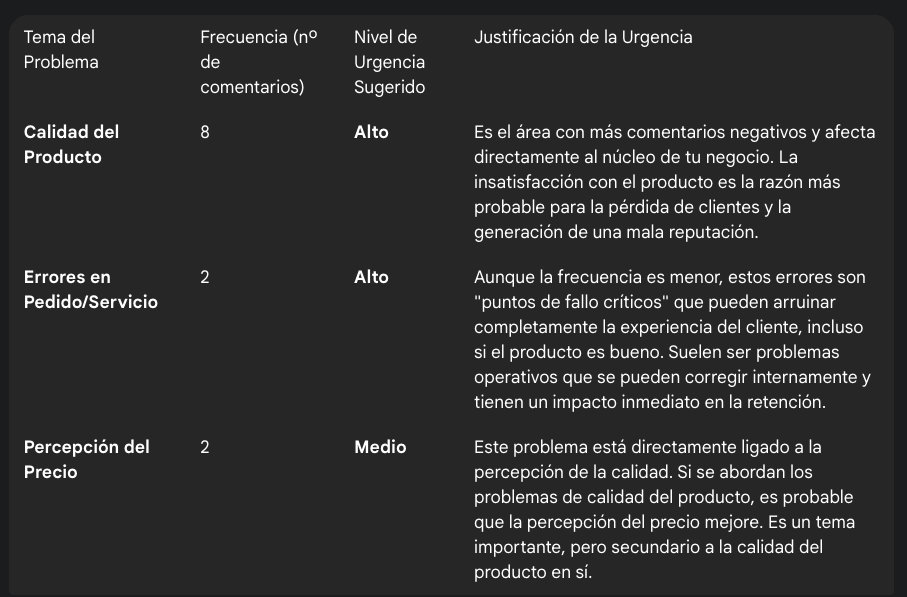
3. **Priority Matrix:** Create a table with three columns: 'Problem Topic', 'Frequency (number of comments)', and 'Suggested Urgency Level (High, Medium, Low)' for business intervention. Briefly justify the urgency level."
Result:
Phase 4: Extracting Value from Positive Sentiment
Positive comments are not just for feeling good; they are a goldmine for marketing.
Prompt 3 (Marketing Intelligence – Positive):
"Now, use only the comments classified as 'Positive'. Your goal is to extract marketing intelligence.
1. **Identify 'Golden Nuggets':** Extract 3-5 literal quotes or testimonials that are powerful and can be used directly on our website or social media.
2. **Detect Value Attributes:** Identify the specific product or service attributes that customers value most (e.g., 'Etiopian coffee tasting notes', 'Custom grind speed', 'Packaging design').
3. **Suggest a Campaign Angle:** Based on these value attributes, propose a primary angle for a future content marketing or advertising campaign."
Result: You will have testimonials ready to use and a clear direction for your next creative briefing. For example: 'Suggested campaign: 'Your coffee, your way, in 24h'. Focus on grind customization and service speed, which are the most valued points.'
Phase 5: Synthesis and Executive Report Creation
The final step is to consolidate everything into a format that you can share with your team or partners.
Prompt 4 (Executive Report):
"Act as a brand strategy consultant. Synthesize the results of the previous analyses (general classification, negative analysis, and positive analysis) into a concise executive report. The report should include:
1. **Executive Summary (3 lines):** General state of brand reputation.
2. **Critical Points to Solve:** Prioritized list of the 3 main problems identified in the negative analysis.
3. **Opportunities to Exploit:** List of the 3 main strengths to boost in marketing, extracted from the positive analysis.
4. **Key Strategic Recommendation:** A single priority recommendation for the coming week (e.g., 'Proactively contact customers with delayed shipments and optimize the logistics provider')."
Result:
This workflow turns a simple AI tool into a brand monitoring and strategy system. It allows you to move from reaction to proactivity, using data not just to observe, but to steer your business with precision.