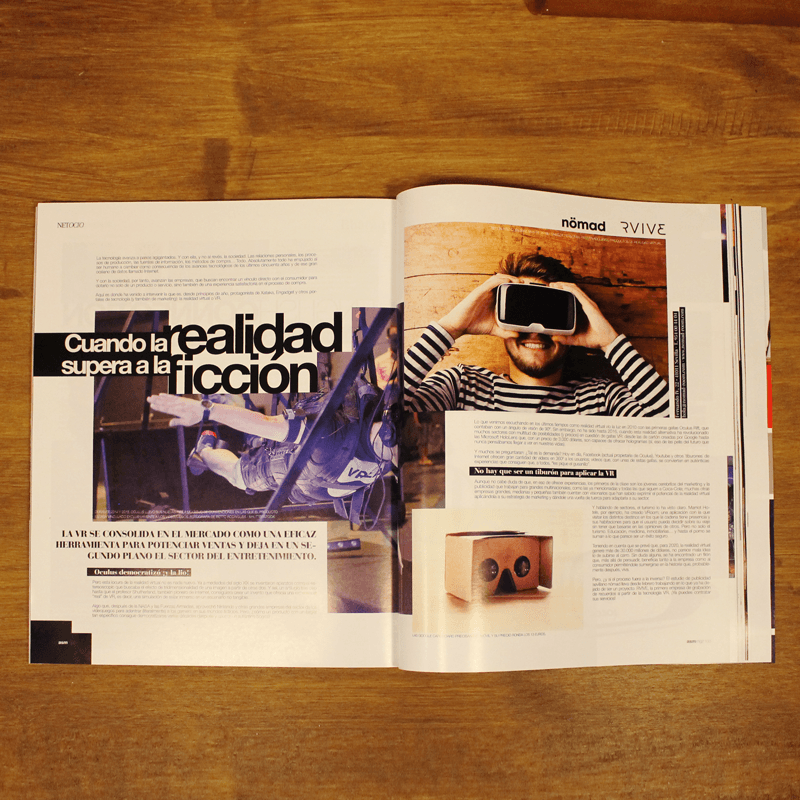
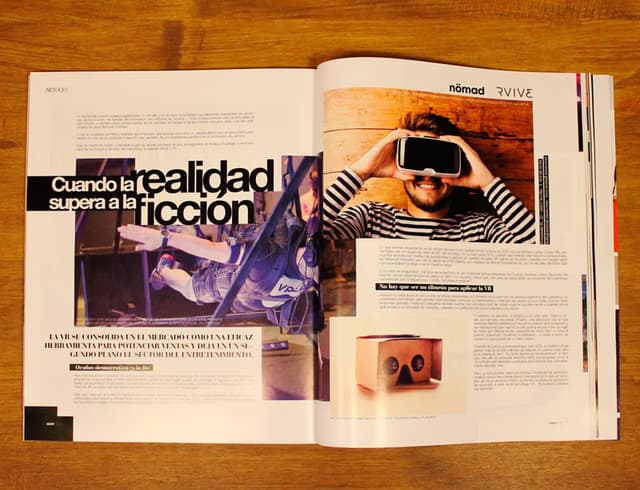
When reality surpasses fiction
Rocio Romero ·
Virtual Reality is becoming a key tool in marketing, tourism, and education. Nömad’s RVIVE project pioneers recording memories in VR, showcasing the technology’s expanding role beyond entertainment.
Privacy and analytics
We use necessary technical cookies and, only with your consent, analytics and marketing pixels to improve the website and measure campaigns.
Rocio Romero ·
Virtual Reality is becoming a key tool in marketing, tourism, and education. Nömad’s RVIVE project pioneers recording memories in VR, showcasing the technology’s expanding role beyond entertainment.

At Nömad, we see new and exciting challenges on our horizon. Among others, we have a virtual reality project in the works that we are working on with special enthusiasm: RVIVE. This world of enormous possibilities is just taking its first steps. It is a field where there is still much to explore, a field that promises multiple uses and applications in different areas.
To share these interests that have been circulating in our studio for some time, we collaborated with ASM Magazine for their October issue with a special feature. It is titled When reality surpasses fiction. We are sharing the text here. You can find the full version in the printed publication:
VR is consolidating in the market as an effective tool for boosting sales, leaving the entertainment sector in the background.
Technology advances at giant strides. And with it, and not the other way around, society does too. Personal relationships, production processes, sources of information, purchasing methods... Everything. Absolutely everything has pushed humans to change as a consequence of the technological advances of the last fifty years and that great ocean of data called the Internet.
And along with society, companies are also advancing, seeking to find a direct link with the consumer to provide them not only with a product or service but also with a satisfactory experience in the purchasing process.
This is where the protagonist of Xataka, Engadget, and other technology (and marketing) portals since the beginning of the year has stepped in: virtual reality or VR.
But this virtual reality craze is nothing new. Already in the mid-19th century, devices like the stereoscope were invented, seeking the 3D effect of an image from two others. And so, one gadget after another until Professor Sutherland, also a pioneer of the Internet, managed to create an invention that offered a “real” VR experience—that is, a simulation of being immersed in a non-tangible scenario.
Something that, after NASA and the Armed Forces, was leveraged by Nintendo and other major players in the video game sector to (literally) draw gamers into their fictional worlds. But how does a product with such a specific target manage to democratize itself several decades later and cause an authentic boom?
What we have been hearing about in recent times as virtual reality saw the light in 2010 with the first Oculus Rift glasses, which had a 90º field of view. However, it wasn't until 2016 that this alternative reality revolutionized many sectors with a multitude of possibilities (and prices) when it comes to VR headsets: from the cardboard ones created by Google to the Microsoft HoloLens which, with a price tag of 3,000 dollars, are capable of offering holograms (yes, that thing from the sci-fi movies we never thought we’d live to see).
And many may ask: Is there such demand? Today, Facebook (current owner of Oculus), YouTube, and other Internet ‘sharks’ offer a large amount of 360º videos to users; videos that, with one of these headsets, turn into authentic experiences that manage to get everyone “hooked.”
Although there is no doubt that, when it comes to offering experiences, the top of the class are the young whiz kids of marketing and advertising working for large multinationals. Like those already mentioned and all those following Coca-Cola. Many other large, medium, and small companies also have visionaries who have known how to squeeze the potential of virtual reality by applying it to their marketing strategy. They have given it a twist to adapt it to their sector.
And speaking of sectors, tourism has seen it clearly. Marriott Hotels, for example, has created VRoom. An application to visit the different destinations where the chain has a presence and their rooms. This allows the user to decide on their trip without having to rely on the opinions of others. But it’s not just tourism. Education, medicine, real estate... and even adult entertainment are joining what seems to be a sure-fire success.
Taking into account that virtual reality is expected to generate more than 30 billion dollars by 2020, jumping on the bandwagon doesn't seem like a bad idea. Without a doubt, a goldmine has been found that, beyond persuasion, benefits both the company and the consumer. It allows the consumer to immerse themselves in the story that they will likely live afterwards.
But what if the process were reversed? The Seville-based Digital Marketing Agency Nömad has been working since February on what has ceased to be a project: RVIVE. The first company for recording memories using VR technology. You can now hire their services!