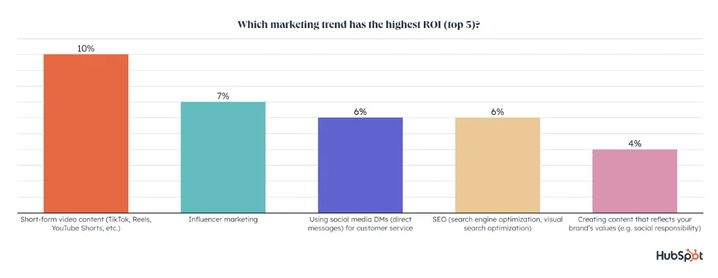
Short-form video is now the preferred content format on social platforms. Brands and services like Spotify and LinkedIn are adopting it widely, while ecommerce explores new advertising and shopping experiences.
Posts
Ideas, copy and a content calendar that sound like your brand
We are Nömad, the agency that propels brands into another dimension. For a decade, we have helped big brands and brands that are big transform their businesses. Here you can take a look at what we've done. Do you need to boost your brand? Find the company type here and we'll tell you what you need to get started.
Platforms that integrate short-form video into their strategies are growing
Undoubtedly, video content is the format most consumed by users on social platforms. Last year, 73% of consumers admitted to preferring short-form videos to learn about a product or service, and 68% are willing to watch a video if it lasts less than a minute.
Data extracted from the report by HubSpot
That is why, beyond TikTok, Instagram, or YouTube, we are seeing more and more social platforms starting to include these formats. Spotify, for example, already shows short looping videos, and on some artist profiles, you can find videos of less than 30 seconds. Now, it also plans to include full music videos. Also, this week we learned that LinkedIn wants to integrate this format into its feed.
Ecommerce brands are also increasing their investment in short-form videos. UberEats is testing a short-form video feed to boost the visibility of restaurants, and Pull&Bear has launched PBShuffle, a new shopping experience integrated into their app that bets on video ecommerce and user-generated content.
The new shopping experience integrated into the Pull&Bear app
The Latest
Meta will label AI-generated content
Meta has announced that starting in May 2024, it will begin labeling content generated with artificial intelligence (AI) on its platforms such as Facebook, Instagram, and Threads. The measure seeks to combat misinformation, especially during election periods, by applying the «Made with AI» label to a wider variety of content, including videos, audio, and images.
Meta is following the path started by YouTube, which has already implemented the “Creator Studio” feature that requires content creators to disclose whether their content has been generated with artificial intelligence.
“Car top” advertising arrives in Spain
Source: Reason Why
“Car top” advertising has arrived in Spain, a common advertising model in North American cities that uses screens on top of ride-sharing or taxi vehicles to display ads with GPS-triggered content.
The company Hangry Media has partnered with Firefly, an advertising network that provides dynamic solutions for brands on the exterior and interior of vehicles, to bring “car top” screens to our country, starting with a pilot program in Madrid and handling the exclusive advertising planning for them. One of the first brands to appear in this new format was Uber Eats.
GPT-4 Turbo is now available to all ChatGPT Plus users
This improved version offers significant improvements, especially in mathematical tasks, and integrates with new features such as Vision, which allows identifying and understanding images. Additionally, OpenAI has launched GPT-4 Turbo through its API, allowing developers to incorporate this advanced technology into applications and services.
This launch coincides with Google’s release of its Gemini 1.5 Pro model, an improved version of Google’s AI model that also introduces new features and enhancements that developers can already take advantage of.
Augmented reality campaigns
Pac-Man chases an Oreo through the center of Madrid
The campaign we are highlighting is this collaboration between Oreo and the legendary video game Pac-Man to promote a limited edition of the cookies. In it, a billboard located in the center of Madrid comes to life and recreates a legendary scene from the Pac-Man video game, thanks to augmented reality technology with FOOH (Fake Out Of Home) video, one of the growing trends in the advertising sector.